Potten End Church of England Primary School
RE
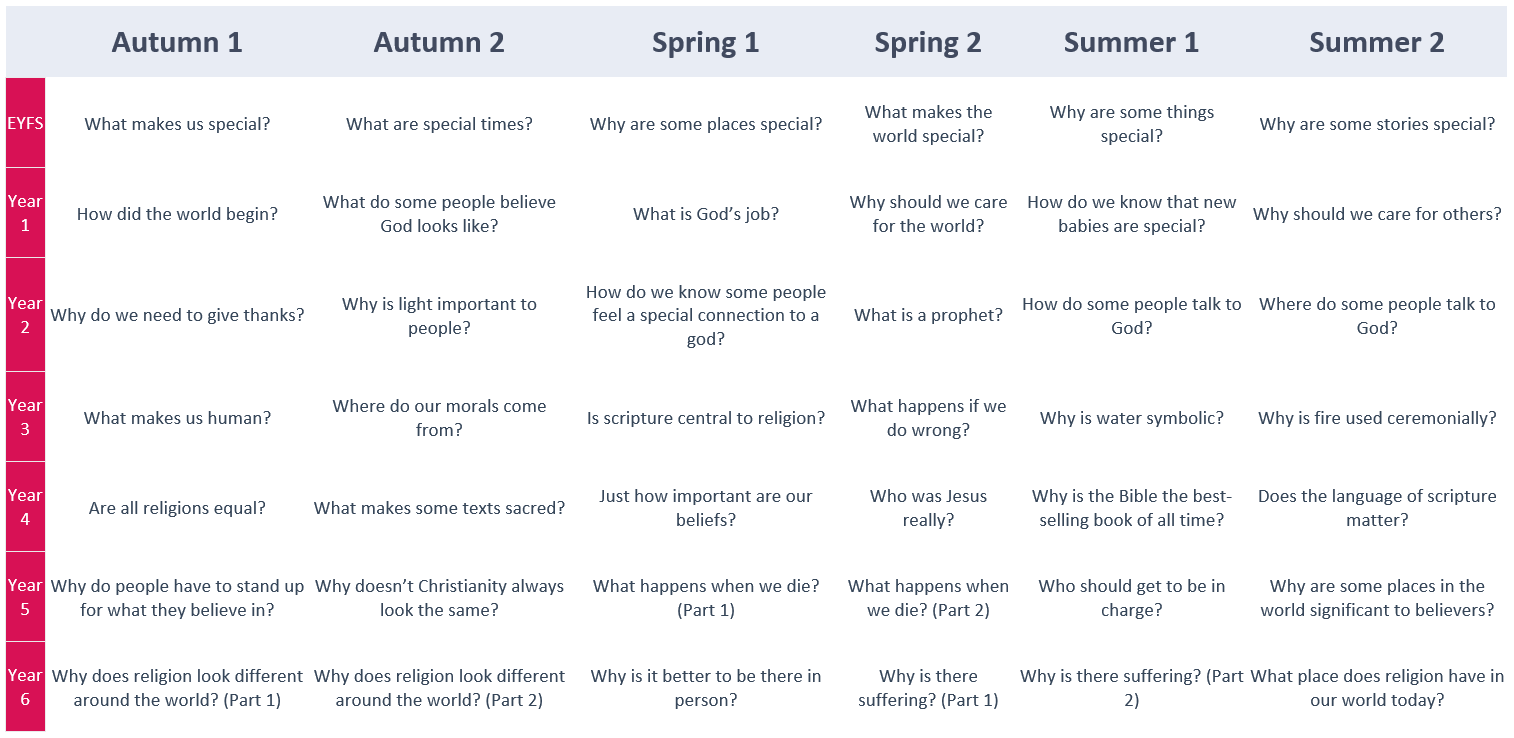
Our curriculum aims to inspire pupils to become curious, reflective and open-minded thinkers. The intention is for pupils to develop the confidence to ask meaningful questions, explore a range of beliefs and worldviews and reflect on their own values and those of others. We follow Kapow Primary’s Religion and worldviews (R&W) scheme of work as well as Hertfordshire Agreed Syllabus.
The curriculum aims to raise awareness of how religion and worldviews influence individual lives, communities and cultures over time. Its goal is to encourage pupils to become respectful and thoughtful citizens who can engage with diversity and contribute positively to a pluralistic society.
Our aims for all children in RE are:
- To develop child’s knowledge and understanding of the six main world religions, religious traditions and views, which offer answers to ultimate questions.
- To encourage children to develop their sense of identity and belonging, in order to flourish within communities as responsible citizens.
- To teach children to develop respect for others and their beliefs and help to challenge prejudice.
By the time the children leave us, they will:
- Ask and offer possible answers to challenging questions about the meaning of life, beliefs.
- Have a secure understanding and knowledge of the religions studied and be confident to answer questions.
- Have a sense of self-identity and belong to flourish within the community and be responsible citizens.
- Show respect, tolerance, and understanding of all religions and beliefs.
- Have a strong understanding of how beliefs, values, practices and ways of life within any religion come together.
Implementation
The curriculum has three strands running through it:
✔ Substantive knowledge (conceptual and worldviews related).
✔ Disciplinary knowledge.
✔ Personal knowledge.
These strands are interwoven across all units to create lessons that build children’s conceptual knowledge and understanding of religion and worldviews (substantive knowledge) and use a range of disciplinary lenses (ways of knowing). Children will also be equipped to explore and express their preconceptions, personal worldviews and positionality (personal knowledge) through varied and engaging learning experiences.
The curriculum follows the spiral curriculum model, where units and lessons are carefully sequenced so that previous conceptual knowledge is returned to and built upon. Children progress by developing and deepening their knowledge and understanding of substantive and disciplinary concepts by experiencing them in a range of contexts.
Each unit includes overarching ‘big questions’ which will be revisited throughout key stage 1, lower key stage 2 and upper key Stage 2, allowing children to apply the breadth and depth of their learning across various concepts. These ‘big questions’ are:
Why are we here?
Why do worldviews change?
What is religion?
How can worldviews be expressed?
How do worldviews affect our daily lives?
How can we live together in harmony if we have different worldviews?
Impact
The impact of the curriculum can be constantly monitored through both formative and summative assessment opportunities. Each lesson includes opportunities for teachers to assess pupils against the learning objectives. Furthermore, each unit has a unit quiz and a knowledge catcher, which can be used at the end of the unit to provide a summative assessment.
After the implementation of the RE curriculum, pupils will be equipped with a range of disciplinary skills and knowledge to enable them to succeed in their secondary education. They will be prepared for life in modern Britain, being able to interact with others from different religious and non-religious viewpoints in a respectful, knowledgeable and open-minded way. They will be curious learners who ask questions and make connections, confident to explore their personal worldview and have the skills to appreciate, evaluate and respond to religious, philosophical and ethical questions.
There is a right for parents to withdraw their children from all or some of the RE curriculum. We would ask parents to make an appointment with school to discuss this.